Books
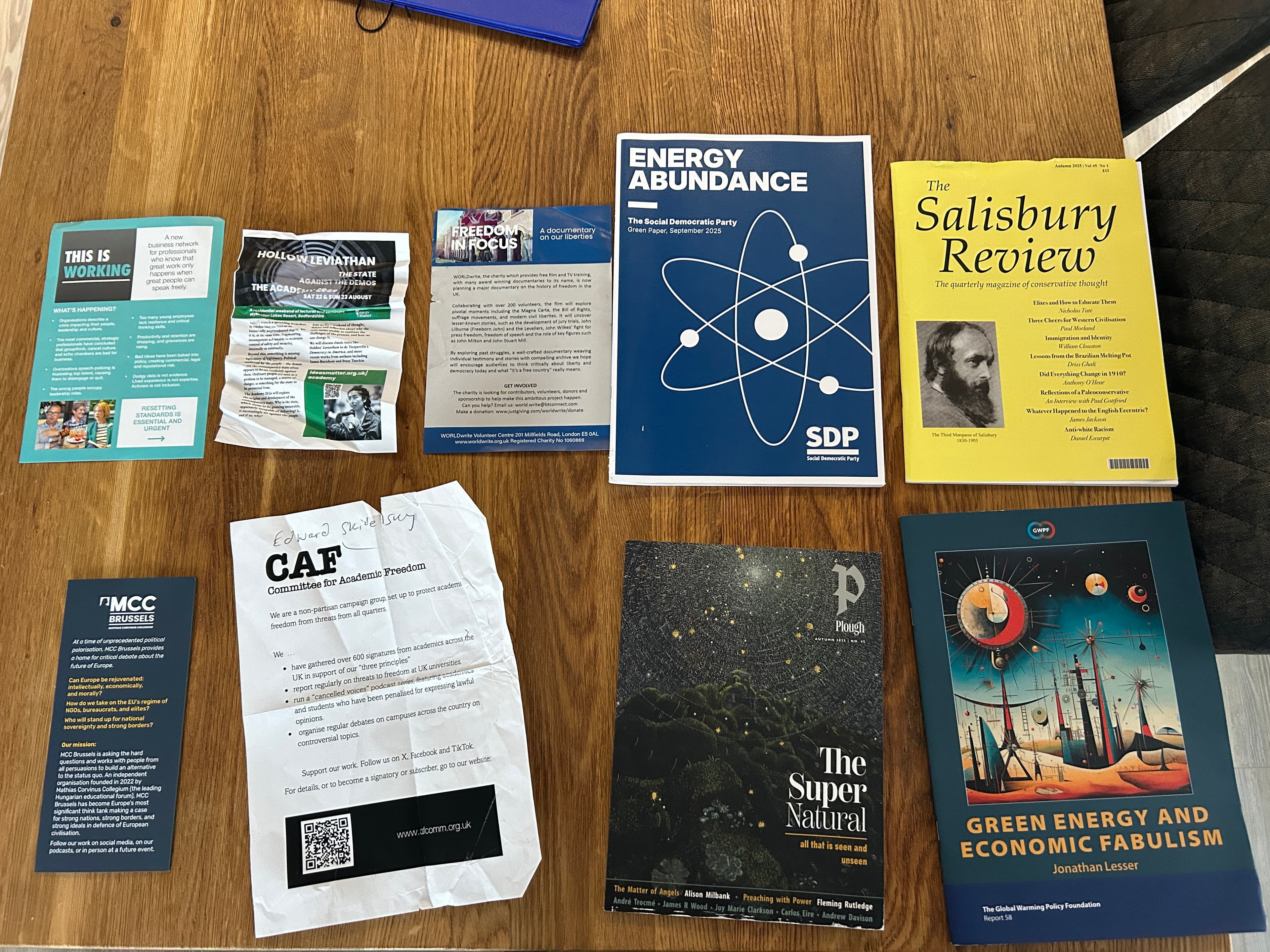
A real reading list, not a picture of one. Titles and short notes on why each book earned its place — core texts first, then supplementary reading and material chosen specifically to be challenged by.
Core texts
- Doughnut Economics— Kate Raworth
A framework for an economy that meets human needs within planetary limits, instead of chasing growth for its own sake.
- Alchemy— Rory Sutherland
Why the most effective solutions are often illogical — psychology beats pure logic in behaviour change and design.
- Thinking, Fast and Slow— Daniel Kahneman
How two different modes of thought — fast intuition and slow deliberate reasoning — shape, and mislead, every decision.
- Small Is Beautiful— E. F. Schumacher
A classic argument for human-scale economics over growth at any cost.
- Livewired— David Eagleman
The brain isn’t fixed hardware — it rewires itself continuously in response to experience.
- The Greatest Crash— David Kauders
A study of financial crises and what causes systems to break under stress.
- The Air We Breathe— Glen Scrivener
On breathing, physiology and the science of a function most people never think about.
- Nudge— Richard H. Thaler & Cass R. Sunstein
How small changes in how choices are presented can improve decisions without removing freedom of choice.
- Thinking in Systems— Donella H. Meadows
The foundational primer on systems thinking — leverage points, feedback loops, and why systems behave the way they do.
- Real World Economics— ed. Edward Fullbrook
A collection challenging mainstream economic orthodoxy with more realistic models of how economies actually work.
- Industrial Dynamics— Jay Forrester
A systems-dynamics text on how structure, delays and feedback drive the behaviour of industrial and economic systems.
- How Countries Go Broke— Ray Dalio
A framework for understanding sovereign debt cycles and how nations arrive at financial crisis.
- Humanocracy— Gary Hamel & Michele Zanini
A case for organisations built around human potential rather than bureaucratic control.
- Material World— Ed Conway
The hidden physical materials — sand, salt, oil, metals — the modern world is actually built from.
- Analytics for the Sharing Economy— ed. Crisostomi, Ghaddar, Häusler, Naoum-Sawaya, Russo, Shorten
Mathematical and engineering foundations for two-sided marketplaces and shared-resource platforms.
- What Every Economics Student Needs to Know— John Komlos
A critique of what standard economics teaching leaves out.
- The Electrical Engineering Handbook— ed. Richard C. Dorf
A comprehensive reference on the engineering fundamentals underneath every electrical system.
- Product Roadmaps Relaunched— Lombardo, McCarthy, Ryan & Connors
How to set product direction under genuine uncertainty, rather than pretending a roadmap is a fixed plan.
+ A book on serverless architectures and event-driven microservices — no good recommendation for this one yet; if you know one, email fight@enleashed.tech and it will be added.
Supplementary reading
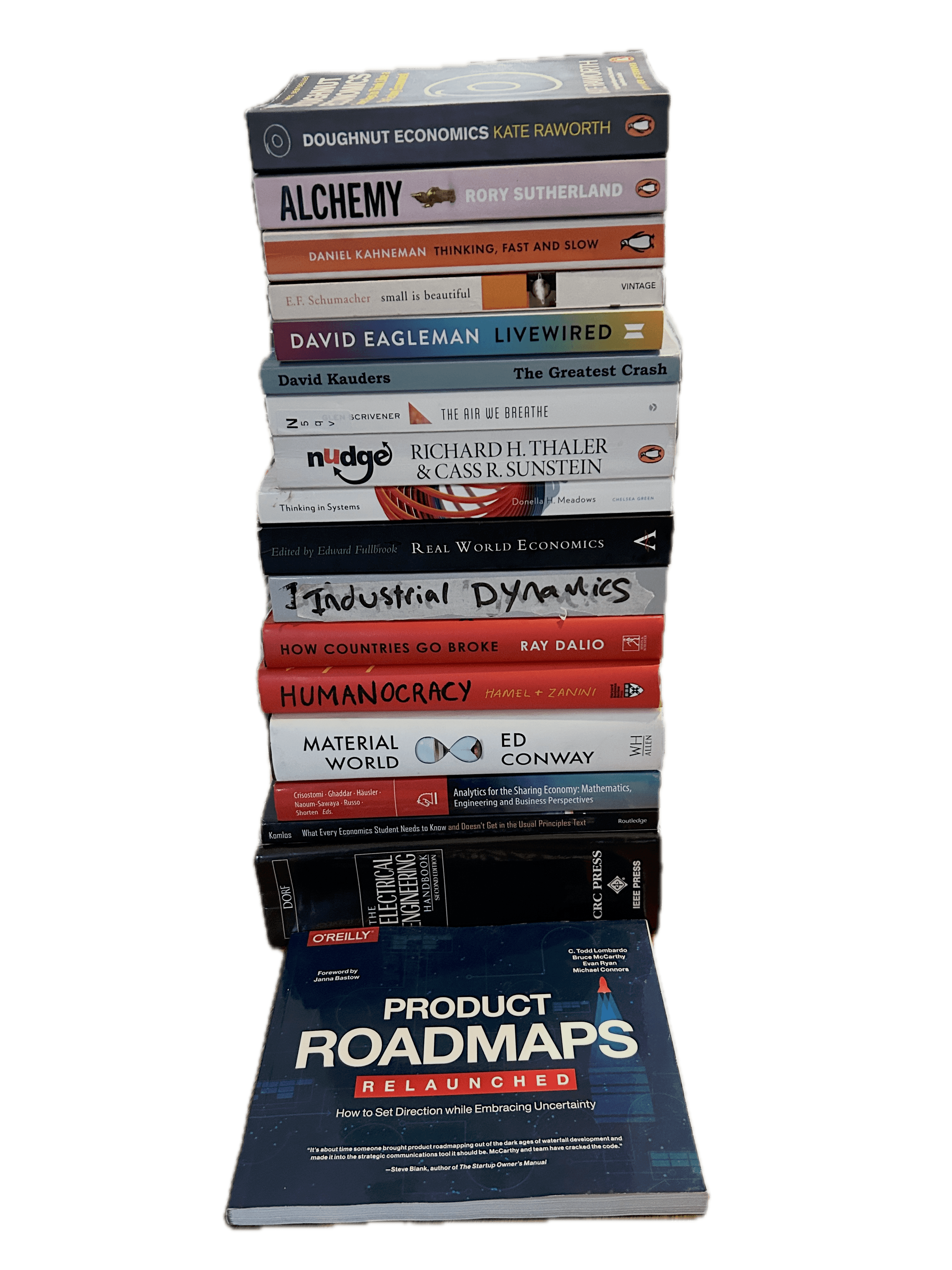
- Ultra-Processed People— Chris van Tulleken
An investigation into what industrially engineered food is doing to human health.
- The Power of Now— Eckhart Tolle
A widely-read argument for presence and attention over anxiety about past or future.
- The Trading Game— Gary Stevenson
A former City trader’s account of how financial markets reward those closest to the money supply.
- Ten Years to Save the West— Liz Truss
A former UK Prime Minister’s account of her time in office and case for economic reform.
- Brave New World— Aldous Huxley
The classic dystopia of a society controlled through comfort and engineered contentment rather than force.
- An Immigrant’s Love Letter to the West— Konstantin Kisin
An argument, from a first-generation immigrant’s perspective, for what’s worth defending in liberal Western societies.
- To Miss With Love— Katharine Birbalsingh
A teacher’s diary-form account of a year inside a struggling inner-city school.
- Dominion— Tom Holland
How Christian moral assumptions — often invisible — still shape Western ethics, even in secular societies.
- Bad Education— Matt Goodwin
A critique of aspects of the education system.
- The Runaway Species— Anthony Brandt & David Eagleman
How human creativity actually works, and why it’s what sets us apart.
- Atomic Habits— James Clear
A practical framework for how small, compounding habits — not willpower — drive real change.
- Time & Social Theory— Barbara Adam
On how different social theories treat the nature of time itself.
- The Coming Wave— Mustafa Suleyman with Michael Bhaskar
An argument that AI and synthetic biology are about to test whether nation-states can contain transformative technology at all — a direct extension of the Seven Transformations thesis.
Challenges & things to think about
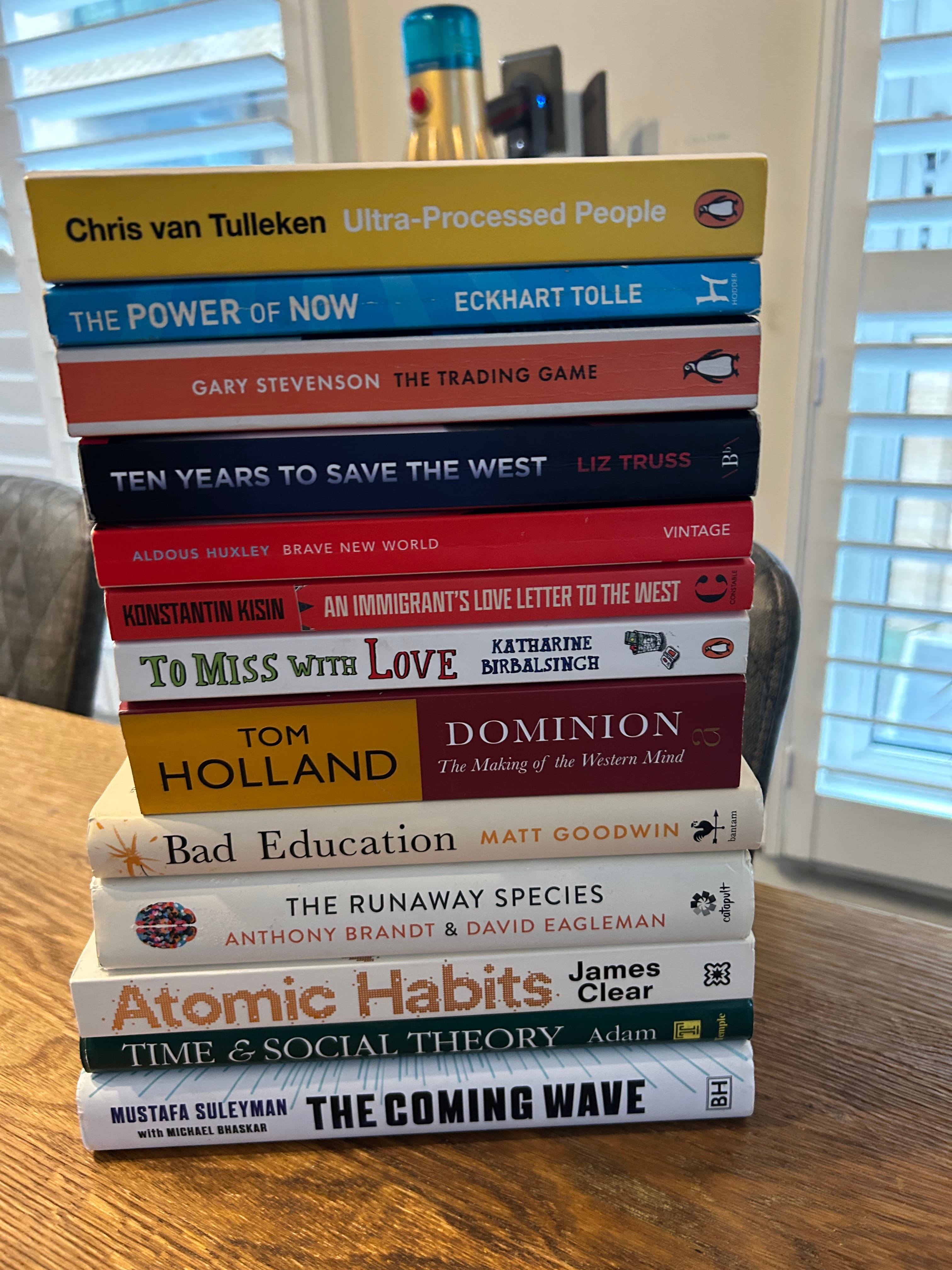
Not a reading recommendation — a photograph of pamphlets, magazines and campaign literature picked up from across the political and ideological spectrum, kept as a reminder to stay exposed to arguments that don't confirm what this mission already believes. Being pictured here isn't an endorsement of any organisation or publication in the photo.